146 Rue de Courcelles
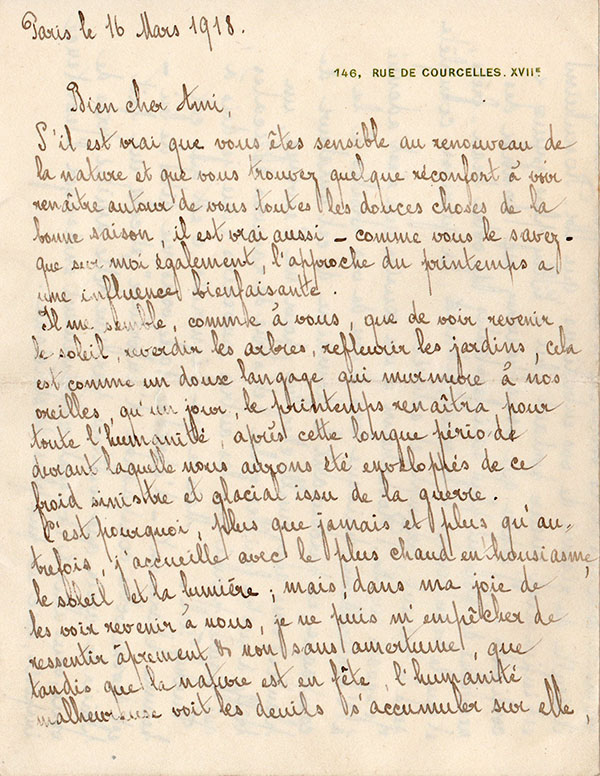
Paris 17th arrondissement
16 March 1918
My dear friend,
If it is true that you are sensitive to the renewal of nature and that you take comfort in seeing all the sweet things of the good season reborn around you, it is also true - as you know well - that the approach of spring also has a beneficial effect on me.
It seems to me, as it seems to you, that seeing the return of the sunshine, the trees becoming green again and the gardens flowering again is like a sweet language murmuring in our ears that one day spring will come again for all humanity after so many years of being wrapped in the sinister and glacial cold of the war.
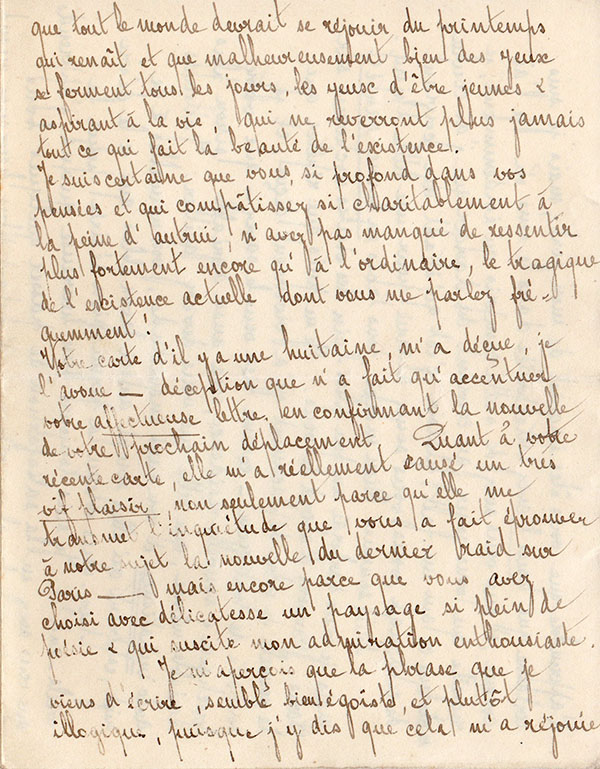
This is why, more than ever, and more than in the past, that I welcome the sunshine and light with the greatest enthusiasm, but my joy at seeing them come back to us is tinged with bitterness at the thought that, while nature is rejoicing, unfortunate humanity has one grief after another piled onto it, and while everyone should be celebrating spring, there are many eyes closing forever each day, eyes of young and hopeful people, who will never see the things that make life so beautiful again.
I am sure that you, who think so deeply and who sympathises so well with the pain of others, have felt more than many the tragedy of life at the moment, about which you talk to me so often!
I must admit that I was upset by your postcard of a week ago and that my distress was heightened by your affectionate letter with the news of your next move. However, your most recent postcard gave me the most intense pleasure, not only because it made me appreciate how much you worried about us when you heard the news about the most recent air-raid on Paris, but even more because you so carefully chose such a poetic landscape, which aroused my enthusiastic admiration.
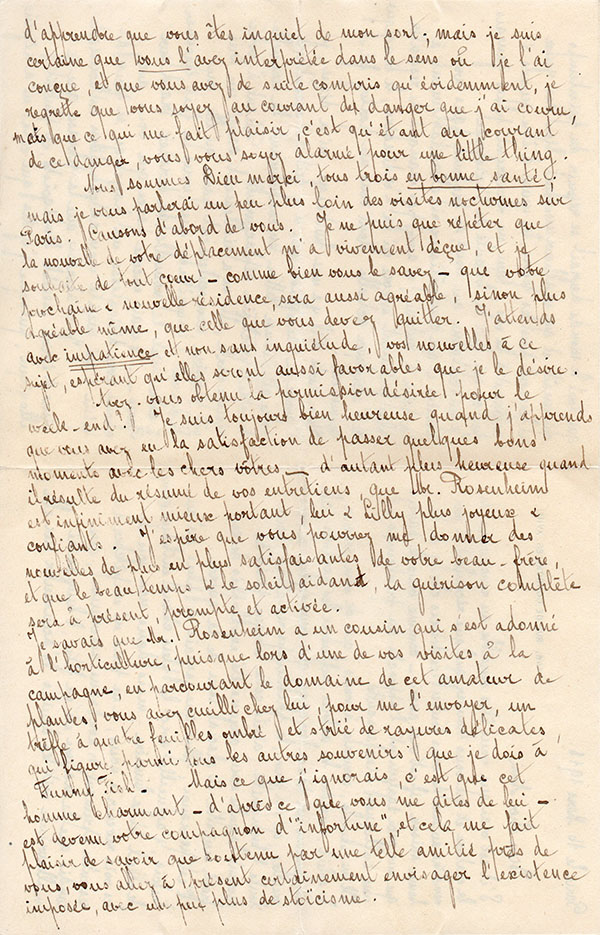
I realise that the last sentence I wrote sounds quite selfish and quite illogical because I said that I was happy that you were worried about me; but I am sure that you will have understood it in the sense that I intended and that you will then have understood that I am sorry that you are aware of the danger that I was in, but what particularly pleased me was that, as soon as you were aware of that danger, you were alarmed for your “little thing”.
We are, thank God, all three of us, in good health and I will tell you later about the night bombardments of Paris. But let’s talk about you first. I can only repeat that the news of your move really upset me and I hope with all my heart - as I am sure you know - that your new billet will be as nice, if not nicer, than the one you must leave. I await your news about this with impatience and not a little worry, and hope the news will be as good as I hoped.
Did you get the weekend leave you requested? I am always so happy when I hear that you have been able to spend some time with your dear relatives, and I was even happier to learn from your report of your conversations that Mr Rosenheim is much better and that he and Lilly are happier and more confident. I am hoping that you will be able to give me some better news about your brother-in-law and that the fine weather and sunshine will help him make a quick and complete recovery.
I was aware that Mr Rosenheim had a cousin who had gone into horticulture, because, during one of your visits to the country estate of this plant-lover, you had picked a four-leaved clover there and sent it to me. This shaded leaf with its delicate stripes is kept with all the other souvenirs “Funny Fish” has sent me. However, I was not aware that this charming man - based on what you have told me about him - had become your “partner in misfortune” and I was pleased to learn that, supported by such a close friendship you will be able to face what life throws at you with a little more stoicism.
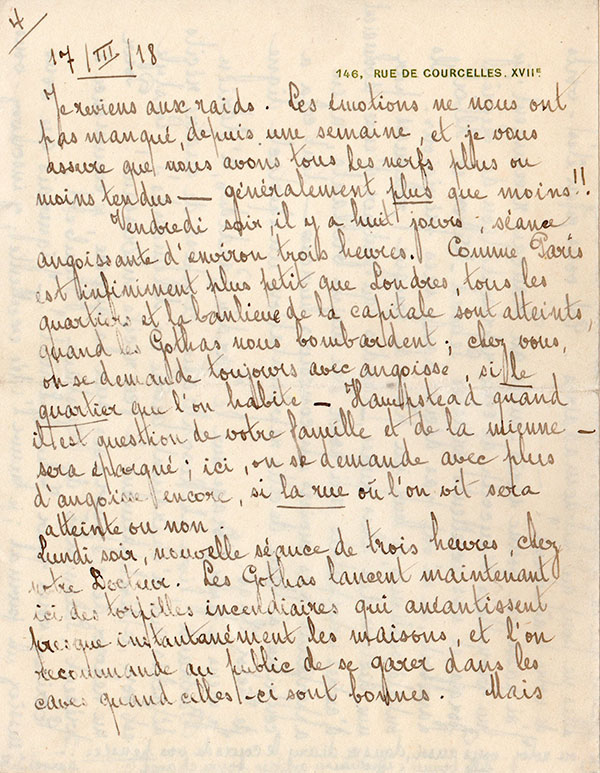
17 March 1918
Now about the bombardments[i]. It has been a pretty emotional week for us all and I can assure you that all our nerves have been more or less on edge - generally more rather than less!!
On Friday evening a week ago, we had a terrifying bombardment for about three hours. As Paris is so much smaller in area than London, all the districts and the suburbs of the capital are hit when the Jerries[ii] bombard us; in London people fearfully wonder if the district where they live will be spared - in the case of both our families that means Hampstead - whereas here in Paris we even more fearfully wonder if the street we live in will be hit or not.
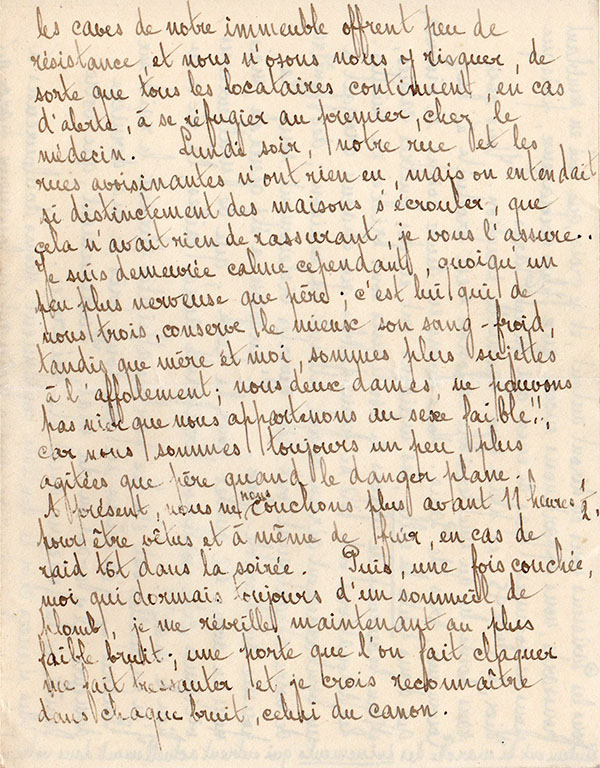
On Saturday evening we had to go down to the doctor’s apartment due to another three-hour bombardment. Now the Jerries are firing incendiary shells which completely destroy houses almost instantaneously, and civilians are advised to take shelter in the cellars of their buildings if they are good. But the cellars of our buildings would not resist much, and, to avoid the risk, all the tenants take shelter instead in the doctor’s apartment on the first floor when the alert is sounded.
During Monday evening‘s bombardment, our street and the neighbouring streets were not hit, but we distinctly heard the sound of houses collapsing, and that really scared us, I can assure you. However, I remained calm, although I was more frightened than Father who, of the three of us, manages to stay the calmest, while Mother and I get into a panic more often; we two ladies cannot deny that we get more agitated than Father when danger looms. At the moment, we no longer go to bed before 11.30pm and remain dressed and ready to flee if there is a bombardment earlier in the evening. Then, once we have gone to bed, I, who used to sleep like a log, am now awoken by the slightest noise: I jump when I hear a door slam and I thing every bang is the sound of a cannon firing.
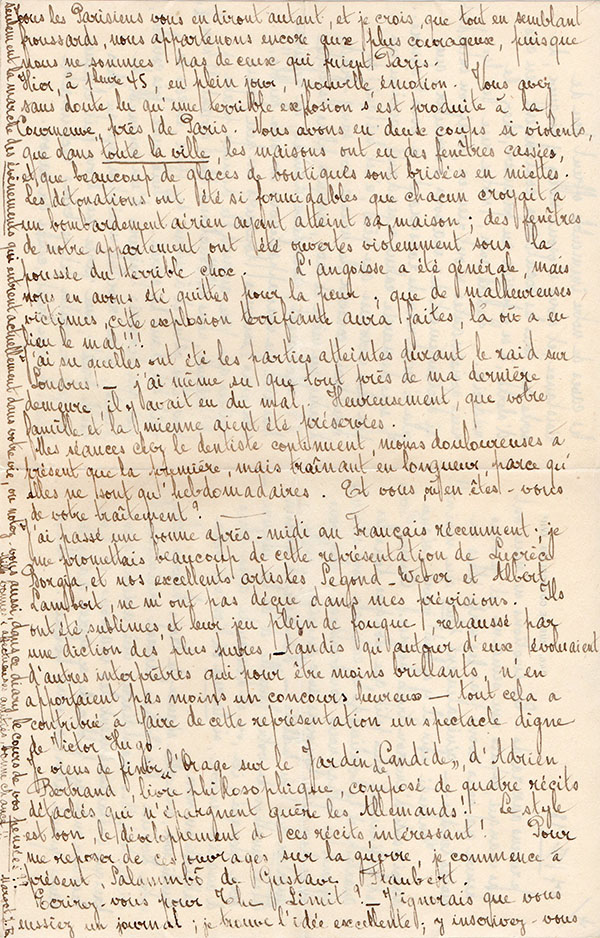
All the Parisians would tell you the same thing and I think that, even though I think we are all scared, we still are among the bravest because we have not fled Paris[iii].
Yesterday at 1.45pm in broad daylight we had another shock. You have no doubt read about the terrifying explosion that occurred at La Courneuve near Paris[iv]. There were two explosions of such violence that houses all over the city had their windows broken and many mirrors in shops were blown to smithereens. The explosions were so strong and loud that everyone thought a shell had hit their houses: our windows were flung wide open by the force of the blast. Everyone was worried but not so much frightened, as we thought of how many lives this terrifying explosion must have claimed close to where it occured!!!
I found out which parts of London were hit during the air-raid and I even discovered that the last house I lived in there had been hit. Fortunately both your family and mine were safe.
My trips to the dentist continue and they are less painful than the first, but they are dragging on as I only go once a week now. And how are you getting on with your dental treatment?
I recently spent an excellent afternoon at the Théâtre des Français[v]; I had been looking forward to this performance of “Lucrezia Borgia”[vi] and was not disappointed by the performances of our excellent artistes Legond Weber and Albert Lambert, who were better than I had hoped. They were sublime, and really threw themselves into their roles, with perfect diction, while the supporting cast contributed to a great performance, even if they were not as brilliant as the stars – this all added up to a spectacular performance that would have impressed Victor Hugo himself.
I have just finished reading “L’Orage sur le Jardin Candide” by Adrien Bertrand, a philosophical book made up of four separate stories which doesn’t spare the Germans![vii] His style is good and he develops the stories interestingly! As a break from these books about the war, I have also started reading “Salammbô” by Gustave Flaubert.[viii]
Are you writing for “The Limit”?[ix] I had no idea you kept a diary, I think it is an excellent idea - do you write down just the day-to-day events of your life or do you also write down your thoughts in this diary??
With a thousand very affectionate friendly wishes and wishing you good luck!
Margot.
Translator's Notes
[i] Margot uses the word “raid” which implies an air-raid by aeroplanes or zeppelins. In fact, Paris was bombarded by shells fired by huge guns located behind the German lines in Eastern France, so I have used “bombardment”. The bombardments began in March 1918 and ended in August 1918. The guns were 120km from Paris and fired 400kg shells that reached a maximum trajectory of 40km above ground level. A total of 367 shells were fired, killing 256 French civilians. [Return to transcript]
[ii] Margot uses “les Gothas” which is far more polite than the usual “les Boches” and which refers to the Almanach de Gotha, the list of German and Continental nobility. I have translated it as “Jerries” being a politer version of “the Hun”. [Return to transcript]
[iii] About 500,000 civilians (out of around 3 million) fled Paris after the bombardments started. [Return to transcript]
[iv] On 15 March 1918, an army warehouse in La Courneuve containing 15,000 hand grenades caught fire and the grenades exploded, killing 24 people nearby and injuring many more. The explosion damaged houses all over Paris and La Courneuve was awarded the French Croix de Guerre by the President of the Republic in 1923 in recognition of its suffering after this disaster. [Return to transcript]
[v] I can find no record of a theatre of this name in Paris so I guess Margot may be referring to the famous Comédie Francaise theatre. [Return to transcript]
[vi] “Lucrezia Borgia” is a play by Victor Hugo, first performed in 1833 that tells the story of the notorious mediaeval aristocratic poisoner Lucretia Borgia. [Return to transcript]
[vii] Adrien Bertrand (1888-1917) was a French novelist and pacifist who nevertheless joined the French army in 1914 and died of his wounds in 1917. The book Margot had read was published after his death in 1917. [Return to transcript]
[viii] Flaubert’s novel was published in 1862 and tells the tale of a priestess in Ancient Carthage and has been described as “an exercise in sensuous and violent exoticism” so would be escapist reading after the Bertrand! [Return to transcript]
[ix] I guess “The Limit” must have been a troops’ newspaper. [Return to transcript]
Translation: Christopher Bourne